Why Your AI Sounds Like a Robot (And Five Knobs That Fix It)
Why Your AI Sounds Like a Robot (And Five Knobs That Fix It) 🤖🔧
Ever wondered why some AI chatbots sound robotic while others feel natural? Or why they sometimes repeat themselves like a broken record, or go completely off the rails with creative nonsense? The secret lies in five magic knobs that control how AI models generate text.
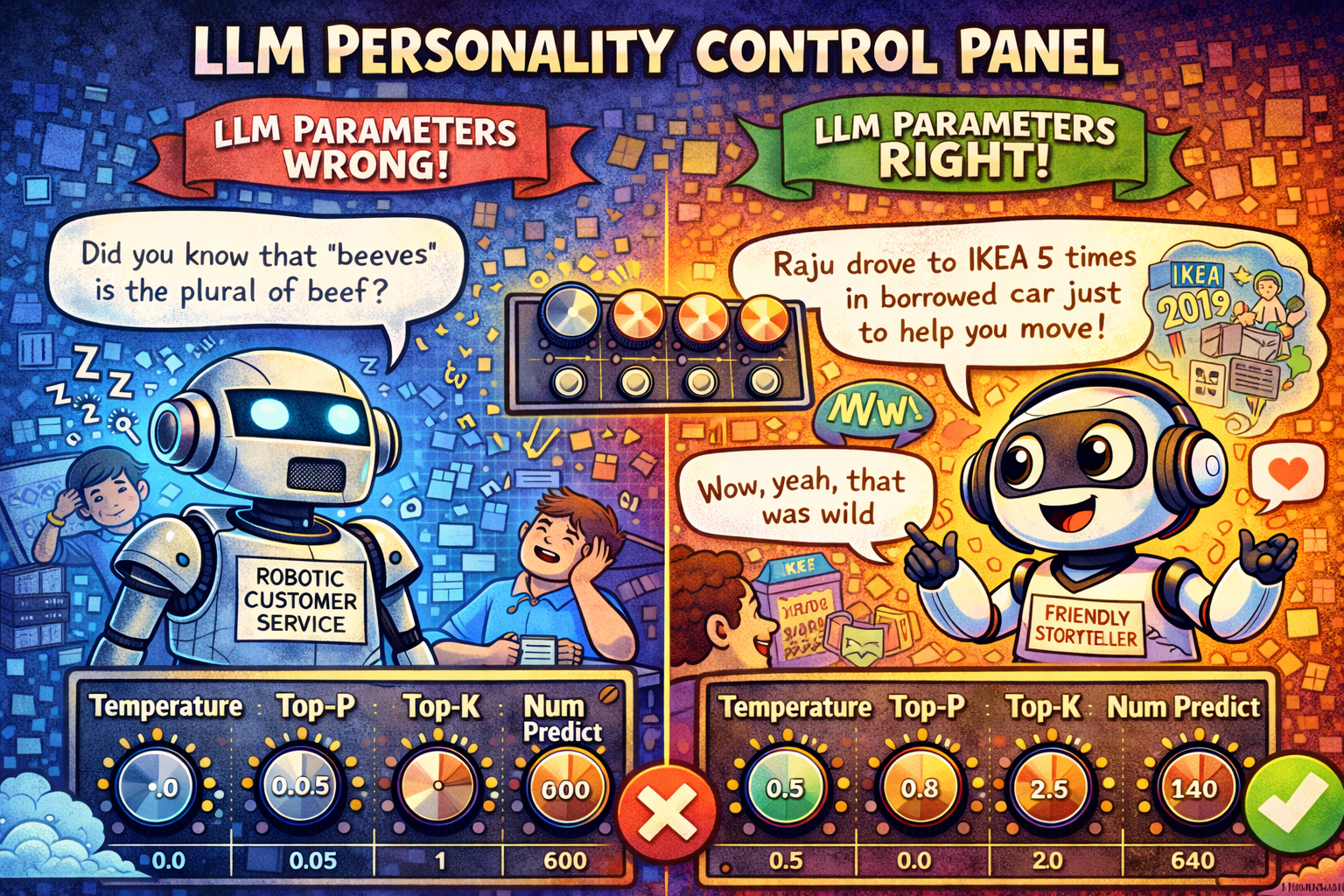
Think of these parameters as the personality dials on your AI assistant. Too conservative, and it becomes a boring textbook. Too wild, and it starts hallucinating stories about your imaginary college roommate "Raju" who never existed.
Let me walk you through the five parameters that transformed my conversational AI from awkward to awesome.
🌡️ Temperature: The Creativity Dial (Sweet Spot: 0.5)
Temperature controls how adventurous the AI gets when picking its next word.
Low temperature (0.0-0.3): The AI always picks the most probable word. Imagine asking it about a beach trip:
"I went to the beach. The beach was nice. We walked on the beach. The sand was on the beach."
Accurate? Yes. Boring? Absolutely.
High temperature (0.8-2.0): The AI throws caution to the wind:
"I traversed the cerulean shores where dolphins telepathically communicated ancient wisdom about the cosmic significance of seashells."
Creative? Sure. Useful? Not really.
Just right (0.5): Natural variation without going bonkers:
"We spent three amazing days in Goa. The beaches were stunning, and we rented a little cottage right by the shore."
That's the sweet spot—detailed enough to sound human, but grounded enough to stay truthful.
🎯 Top P: The Vocabulary Filter (Sweet Spot: 0.8)
Top P (nucleus sampling) decides which words are even in the running. Set to 0.8, it means "only consider words that make up the top 80% probability."
Here's how it works in practice: When the AI is about to say "The beach was...", it looks at all possible next words ranked by probability:
- "beautiful" (15% probability)
- "stunning" (12% probability)
- "gorgeous" (10% probability)
- "nice" (8% probability)
- "lovely" (7% probability)
- "amazing" (6% probability)
- ... and hundreds more
With Top P set to 0.8, the AI adds up probabilities until it hits 80%, then stops considering the rest. This means it might use "beautiful," "stunning," or "gorgeous," but it won't reach for low-probability words like "pulchritudinous" (0.001% probability) or completely out-of-place options.
Without Top P, your AI might describe breakfast as "I partook in matutinal sustenance" instead of "I had breakfast." The words are technically correct, but nobody talks like that.With 0.8, it has enough vocabulary for natural variety while staying conversational. Think of it as giving your AI access to a normal person's vocabulary, not a thesaurus-obsessed literature professor.
🛡️ Top K: The Safety Net (Sweet Spot: 30)
While Top P uses probability, Top K just counts: "Pick from the 30 most likely next words. Ignore the rest."
Why does this matter? Let's say you're describing a trip:
Without Top K: The AI considers 5,000 possible next words, including "We embarked upon our aquatic sojourn..."
With Top K=30: It only looks at common, natural options: "We went on our trip..."
Together with Top P, they form a tag team: "Be natural (Top P) and avoid weird choices (Top K)."
🔁 Repeat Penalty: The Anti-Broken-Record (Sweet Spot: 1.2)
This is where I learned an important lesson. My first attempt used a repeat penalty of 2.0 (aggressive). The result?
"We traveled to Goa. Subsequently, we acquired temporary residence near the shoreline. The experience proved enjoyable."
It was so terrified of repeating words, it sounded like a legal document.
Dialed back to 1.2, it allows natural language patterns:
"We went to Goa and rented a cottage by the beach. We spent our days exploring the area and our evenings watching the sunset."
Notice how "we" appears multiple times? That's normal speech! A repeat penalty of 1.2 discourages annoying loops without forcing awkward synonyms.
📏 Num Predict: The Story Length Limit (Sweet Spot: 800)
This caps how many tokens (roughly words) the AI can generate. Too short, and stories get cut off mid-sentence. Too long, and it rambles.
800 tokens is perfect for a complete, detailed story without wandering into unnecessary tangents.
✨ The Magic Combination
Here's why these parameters work together beautifully:
Question: "Tell me about your beach trip"

Temperature 0.5 → "Be creative, but stay grounded"
Top P 0.8 → "Use natural vocabulary"
Top K 30 → "But nothing weird"
Repeat Penalty 1.2 → "Vary phrasing naturally"
Num Predict 800 → "Tell the full story"

Result ↓
Before tuning (temp=0.4, repeat_penalty=2.0):
"Goa proved satisfactory. Coastal activities ensued. The accommodation met expectations."
After tuning (temp=0.5, top_p=0.8, top_k=30, repeat_penalty=1.2):
"Oh, Goa was absolutely magical! We rented this little cottage right by the beach—you could hear the waves from the bedroom. Spent three carefree days just soaking in the sun, trying local seafood, and watching the most stunning sunsets. Your mother loved it; she'd walk along the shore every morning collecting shells. One of my favorite memories, truly."
See the difference? Same facts, completely different experience.
⚖️ Real-World Trade-offs
| Use Case | Temperature | Top P | Top K | Repeat Penalty | Num Predict |
|---|---|---|---|---|---|
| Maximum accuracy (factual Q&A) | 0.3 | 0.7 | 20 | 1.3 | - |
| Shorter, punchier responses | 0.4 | - | - | - | 400 |
| Creative storytelling | 0.6 | 0.9 | - | 1.1 | - |
| Code generation (precise syntax) | 0.2 | 0.5 | 10 | 1.5 | - |
| Conversational chatbot (balanced) | 0.5 | 0.8 | 30 | 1.2 | 800 |
| Brainstorming ideas (high creativity) | 0.8 | 0.95 | 50 | 1.0 | - |
| Technical documentation | 0.3 | 0.6 | 15 | 1.4 | 1200 |
| Social media posts (catchy & brief) | 0.7 | 0.85 | 40 | 1.3 | 280 |
💡 The Lesson
Think of LLM parameters as the personality control panel for your AI. Get them wrong, and you'll either end up with a boring encyclopedia that puts you to sleep mid-sentence, or a creative maniac inventing elaborate backstories about your imaginary best friend "Raju" who apparently helped you move apartments in 2019 (spoiler: Raju never existed).
My magic numbers (0.5 temp, 0.8 top_p, 30 top_k, 1.2 repeat_penalty) turn my AI from "robotic customer service nightmare" into "that friend who actually remembers your stories." Your perfect settings? Probably different. That's the beauty—no two AI personalities are the same.
Here's the plot twist: these five knobs exist in basically EVERY LLM framework. OpenAI? Check. Llama? Yep. That random model your friend keeps raving about? Probably has them too. It's like discovering that all cars have steering wheels—revolutionary, I know.
So next time your AI starts sounding like it swallowed a thesaurus, or keeps saying "beach beach beach beach" like a broken record, resist the urge to rage-quit. Just fiddle with the knobs. Your AI isn't broken—it's just wearing the wrong personality settings.
Have you experimented with LLM parameters? What's your sweet spot?